

Curve Finance implements soft liquidation model to aid borrowers
Curve Finance's soft liquidation model could enhance DeFi's appeal to institutional investors by mitigating abrupt liquidation risks.
 CryptoBriefing•Editorial Team8 Sept
Curve Finance's soft liquidation model could enhance DeFi's appeal to institutional investors by mitigating abrupt liquidation risks.
CryptoBriefing•Editorial Team8 Sept
veCRV holders backed yRisk with 536.9 million votes and none against, then funded the mandate on Sept. 2 with 125,000 frxUSD and 568,181 CRV. yRisk's two contributors are the primary developers of Resupply, which lost $9.6 million to an exploit in June 2025, a fact absent from the proposal and from
 The Defiant•The Defiant Team3 Sept
How CRV crypto rallied by double-digits as demand for DeFi protocols grew.
 AMBCrypto•Lennox Gitonga2 Sept
ARB and CRV are back in the top 100 alts after massive daily gains of 24% and 15%, respectively.
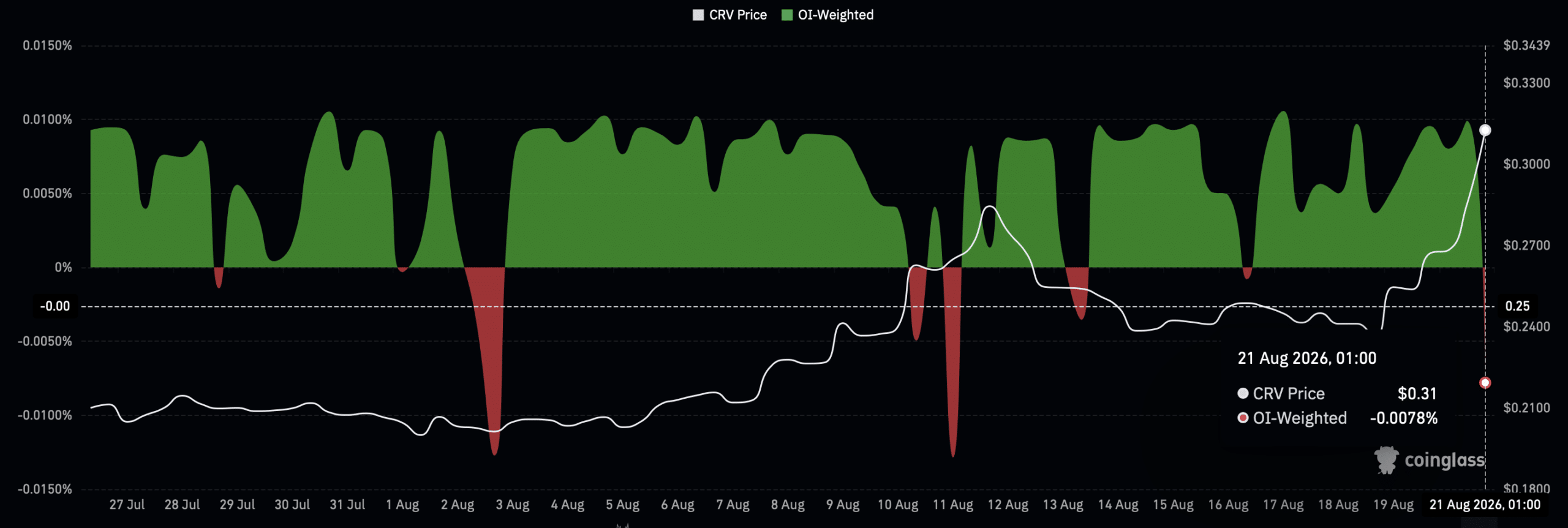
Can a rally look crowded when its active user base remains this small?
AMBCrypto•Olayiwola Dolapo21 Aug
Yield Basis' success highlights DeFi's potential to attract significant trading volumes and liquidity, emphasizing its role in volatile markets.
CryptoBriefing•Editorial Team19 Aug
Pump.fun's rapid growth has brought massive revenue, but questions over token quality and platform behavior continue to follow the launchpad.

Curve Finance founder Michael Egorov has called Pump.fun “a casino of scams called memecoins” while referring to Phantom’s hardware-wallet experience as worse than Metamask’s, prompting pushback from industry personnel. Blunt Critique at Its Finest Michael Egorov, the founder of Curve Finance, has taken direct aim at two of Solana’s most prominent consumer products, describing Pump.fun, […]
 Bitcoin.com News•Shiraz Jagati17 Aug
CRV extends its bullish breakout as rising Open Interest and whale activity strengthen the case for a move toward $0.30.
AMBCrypto•Kelvin Murithi12 Aug
In this Curve DAO Token (CRV) price prediction 2025, 2026-2030, we will analyze the price patterns of CRV by using accurate trader-friendly technical analysis indicators and predict the future movement of the cryptocurrency. TABLE OF CONTENTS INTRODUCTION Curve Dao (CRV) Current Market Status What is Curve Dao (CRV)? Curve Dao
 TheNewsCrypto•Hannah Carter14 Jul
The Curve DAO native token has a higher timeframe bias and the $0.266 level was a key resistance.
AMBCrypto•Akashnath S14 Jun
The Fidelity Digital Dollar stablecoin deployed Curve Finance Stableswap LP positions and Uniswap LP positions simultaneously in a single Ethereum block Thursday evening, with Curve founder Michael Egorov noting the same-block execution as evidence of DeFi operational expertise.
The Defiant•The Defiant Team11 Jun
April was a bad time for the crypto industry. Over the past month, 29 crypto projects have suffered hacks or exploits, the highest monthly tally in the industry’s history, per DefiLlama data. Among them were two standouts: The hacks of Solana-based exchange Drift, and Ethereum-based restaking app Kelp DAO, which resulted in a combined $579 million loss. The situation has sparked a crisis of confidence among the industry’s most ardent believers and left them questioning whether the tradeoffs inherent in decentralised technology are worth the trouble. In recent years, the number of crypto hacks — and the amounts stolen — have edged higher. The fast-moving and experimental DeFi space, once notorious for exploits, was thought to have matured. But now it’s back in the limelight — and not for the right reasons. “Right now, DeFi seems to be the primary target,” Michael Pearl, vice president of strategy at crypto security firm Cyvers, previously told DL News . “In general, everything has shifted now to hacking humans rather than hacking systems.” Single points of failure The problem, according to Michael Egorov, founder of DeFi protocols Curve Finance and Yield Basis, is centralisation. “We need to reduce the number of single points of failure as much as possible,” Egorov said in a statement shared with DL News . “The goal of DeFi design should be to minimise human-centric points of failure, not add to them.” The attacks on Drift and Kelp DAO both ultimately came down to centralised weak points. North Korean hackers compromised two Drift employees through an elaborate social engineering campaign. This gave the hackers the power to make admin changes to the protocol, allowing them to steal some $285 million from users. As for Kelp DAO, the instance of the LayerZero crypto bridge the protocol relied on was configured to only require a single operator, which hackers exploited to steal $273 million. Yet centralisation is not the only way DeFi protocols are getting caught out. Last month, 24 out of the 29 incidents — almost 83% — were caused by code bugs. Crypto security experts previously told DL News that advances in artificial intelligence are making it cheaper, easier, and faster for hackers to attack DeFi protocols. Bad actors are now using the large language models that power AI chatbots like ChatGPT and Claude to search through thousands of lines of code a second. Before, they had to do so manually. Despite code bugs being the root cause of the majority of hacks, they only accounted for $42 million of April’s $635 million in losses — around 6.6%. Not the biggest loss Despite a record 29 hacks, April wasn’t the worst month by the amount of funds lost. In December 2020, hackers reportedly stole some $3.5 billion. Yet this month is often considered an outlier because the vast majority of that figure came from the hack of wallets belonging to LuBian, a Bitcoin mining company. Neither LuBian nor the suspected hacker have ever publicly acknowledged the breach, and it remained unnoticed for almost five years. Arkham Intelligence, the blockchain data platform that discovered the hack, said it was likely due to LuBian's use of a flawed private key generation algorithm that left it susceptible to brute-force attacks. The next biggest loss came in February last year when North Korean hackers swiped $1.5 billion from crypto exchange Bybit. Additionally, hackers also stole slightly more than in April in August 2021, March 2022 and October 2022 respectively. Tim Craig is DL News’ Edinburgh-based DeFi Correspondent. Reach out with tips at tim@dlnews.com .