



Uniswap launches U-USDG stablecoin pool on Robinhood Chain
The launch enhances Robinhood Chain's DeFi ecosystem, potentially increasing stablecoin liquidity and competition among decentralized exchanges.
 CryptoBriefing•Editorial Team10h ago
The launch enhances Robinhood Chain's DeFi ecosystem, potentially increasing stablecoin liquidity and competition among decentralized exchanges.
CryptoBriefing•Editorial Team10h ago
UNI just delivered a strong 2x expansion into 6.841, and that vertical move is exactly where the first setup begins to build. 🟠 Why This Level Matters: Price has run into resistance after an aggressive impulse, and momentum this stretched rarely holds without a pullback. The local lows sit right below current price and act as the neckline for the next move. A break there flips the short-term structure lower. 🟠 Gameplan / Primary Scenario: The focus for the next 30 days is the first move: sell the break of local lows once the neckline gives way, and ride the short back into the 3.000 range. This is the immediate play — the sideways rotation and later MSB long from resistance come after, so keep them on the radar but trade the breakdown first. No entry until the neckline breaks and confirms. If this added value, boost it forward. What are your thoughts? Swallow Academy

Apia, Samoa, September 17 – HTX Research, the dedicated research arm of HTX, has released a new report titled Stock-Linked Memecoins: Issuance, Liquidity, and the Emerging AMM Stack, a systematic study of a new asset category that emerged following the launch of Robinhood Chain. These memecoins are paired directly with stock tokens representing names such as NVDA, TSLA, HIMS, and MU, using them as quote asset, narrative anchor, or liquidity base. The report finds that they combine public-equity price discovery, crypto attention, AMM inventory, and continuously traded sentiment into a single market structure — the short-term growth case holds, but durability depends on four conditions being met simultaneously. A New Market Structure A stock-linked memecoin is a second-order equity exposure. The stock token provides a first-order price anchor, while the memecoin trades the culture, events, and sentiment surrounding that stock, often with volatility far exceeding the underlying. It resembles an attention derivative on an equity theme rather than a legally structured equity derivative. Robinhood Chain is unusually well suited to this experiment. Robinhood brings a recognized retail-equity brand and stock tokens carrying familiar company symbols rather than an abstract RWA narrative; Uniswap became a major liquidity venue from launch; and O1 Launchpad productized the process of selecting a stock token, creating a memecoin, opening a Uniswap v4 market, and allocating trading fees. As of September 8, 2026, DeFiLlama reported approximately $901 million in Robinhood Chain TVL and $1.727 billion in 24-hour DEX volume. Multi-Hop Routing and Toll Collectors on Attention Value capture extends beyond the memecoin itself. A trader buying a stock-linked memecoin may travel from WETH to USDG to a stock token and finally to the memecoin, with a single order generating fees for several pools along the way. During a short-lived attention spike, volume rises sharply while liquidity remains thin, and liquidity providers become the ecosystem’s most direct toll collectors on attention. High fees, however, do not imply high net returns. Risks including out-of-range positions, one-sided inventory, impermanent loss, stock-market closures, stock-token premiums or discounts, and incentive-token depreciation can all outweigh headline fee income. As HTX Research emphasizes, fees are compensation for risk, not free interest — LPs bear the risk of continuously filling at the wrong price, while traders bear the risk of picking the wrong token. The 100,000% APY Illusion Market commentary has cited displayed APY above 100,000% for supplying high-fee Uniswap v4 liquidity to stock-linked memecoins. The report dismantles this figure, noting that a short observation window, sudden volume surge, small TVL base, and compound extrapolation are all it takes to display an extreme annualized rate. If a $100,000 position earns $200 in one hour, simple annualization produces approximately 1,752%, and hourly compounding turns it into an astronomical number. Annualized metrics also ignore denominator effects — when a memecoin collapses, dividing unchanged fees by a smaller ending TVL inflates the displayed yield. The report proposes a more robust test: the fee-coverage multiple – realized fees and monetized incentives divided by losses relative to a simple hold portfolio, rebalancing costs, and hedging costs. Only a multiple above one indicates that market making has compensated for its risk. High APY still carries information value as a signal of dense order flow relative to effective depth, and professional LPs can treat it as a flow radar rather than a return promise. Four Conditions and the Real Questions HTX Research identifies four questions that will determine whether stock-linked memecoins evolve from an onchain experiment into a durable market structure: Are Robinhood’s native users actually moving onchain? Do stock-token redemption and pricing remain stable during extreme moves and market closures? Does issuance from O1 and comparable platforms turn into markets with two-sided depth after seven and thirty days? Can AMMs preserve effective depth and organic volume as subsidies fall? If the answer to each is yes, stock-linked memecoins can become a high-volatility front end for the internetization of equities, with issuance platforms and AMMs forming a new market stack. If not, the current heat is more likely a temporary experiment driven by low float, heavy subsidies, cheap issuance, and transient attention. Either way, 100,000% APY should never be the endpoint of research. As HTX Research points out, the relevant questions are who pays the fee, who carries the inventory, who can exit, who controls protocol parameters, and whether revenue survives after incentives stop. This reflects HTX Research’s consistent approach to emerging market forms — dissecting structure, fee attribution, and risk sources before drawing conclusions from headline figures. HTX Research will continue tracking issuance, liquidity, and user-composition shifts across Robinhood Chain and comparable ecosystems, providing structural analysis grounded in onchain data. About HTX Research HTX Research is the dedicated research arm of HTX Group, responsible for conducting in-depth analyses, producing comprehensive reports, and delivering expert evaluations across a broad spectrum of topics, including cryptocurrency, blockchain technology, and emerging market trends. Committed to providing data-driven insights and strategic foresight, HTX Research plays a pivotal role in shaping industry perspectives and supporting informed decision-making within the digital asset space. Through rigorous research methodologies and cutting-edge analytics, HTX Research remains at the forefront of innovation, driving thought leadership and fostering a deeper understanding of evolving market dynamics. Visit us. Connect with HTX Research Team: research@htx-inc.com
 NewsBTC•BlockmanPR16h ago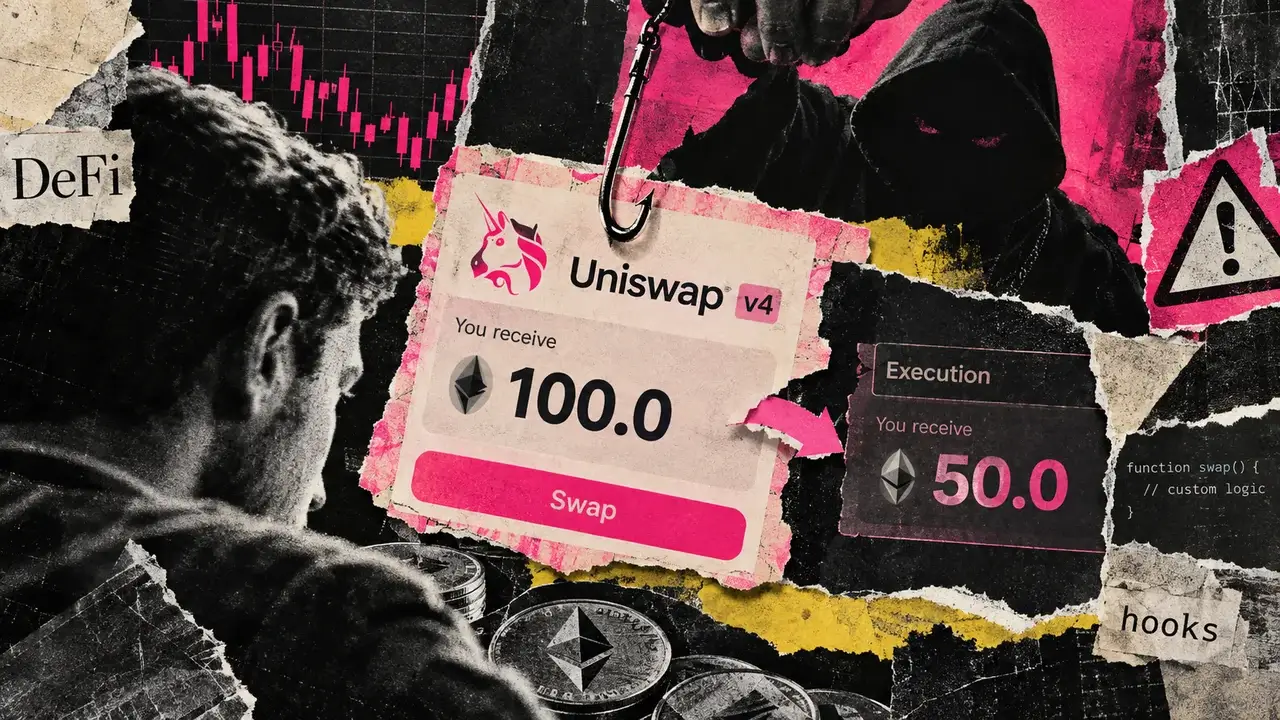
Malicious Uniswap v4 hooks can win aggregator routing with attractive quotes, then change behavior when a user's transaction settles.
 CryptoSlate•Gino Matos16 Sept
The Layer 1 charges gas in USDC and runs proof-of-authority across a permissioned set of 11 institutions plus Circle. More than 100 applications are live at launch, with Aave, Morpho and Uniswap anchoring DeFi. Circle minted 10 billion ARC tokens this week without committing to a public launch.
 The Defiant•The Defiant Team16 Sept
The Layer 1 charges gas in USDC and runs proof-of-authority across a permissioned set of 11 institutions plus Circle. More than 100 applications are live at launch, with Aave, Morpho and Uniswap anchoring DeFi. Circle minted 10 billion ARC tokens this week without committing to a public launch.
The Defiant•The Defiant Team16 Sept
The debate highlights the ongoing challenge in DeFi of balancing innovation with security, emphasizing the need for robust verification systems.
CryptoBriefing•Editorial Team15 Sept
The DEX aggregator found 54.2% of the 84,163 hooks it analyzed were malicious. Uniswap's founder and Paradigm's Dan Robinson said the failure is in 0x's routing.
The Defiant•The Defiant Team15 Sept
Does $7.50 become a breakout door or a liquidation trap for crowded longs?
 AMBCrypto•Kelvin Murithi15 Sept
RAIN has plummeted the most from the larger-cap alts, while UNI and XLM are among the few exceptions in the green today.

Uniswap's innovative StablePair Hook could reshape decentralized finance by enhancing stablecoin trading efficiency and liquidity on Ethereum.
CryptoBriefing•Editorial Team15 Sept
Welcome to my page! I share daily technical analyses of crypto and other charts here. BINANCE:UNIUSDT 💡Market Analysis: UNI is consolidating inside the 6.124–6.491 range after recovering from the 5.886 support level. Price is now testing the local bullish trigger area around 6.39. The long setup is based on a confirmed breakout of the marked trigger with a strong bullish candle body above 80%, or a clean pullback that holds the broken level. The first objective is around the 6.48–6.49 area, followed by the second marked target near 6.59. If bullish momentum continues, 7.048 becomes the next major resistance and extended target. A failed breakout and loss of the marked invalidation area around 6.33 would weaken the setup and shift attention back toward the 6.124 support. As with my previous setups, I use the marked solid and dashed levels only as triggers and wait for breakout confirmation rather than entering simply because price touches a level. Key Support & Resistance: Key Resistance: 6.491 / 7.048 / 7.360 Key Support Area: 6.124 / 5.886 / 5.702 🎯 Trade Entry & Exit Plan: Entry : Breakout/Pullback of trendline or key zones with >80% candle body confirmation. Stop Loss : Behind the last wave or the last breakout candle. Take Profit : Minimum R:R 2, with further targets at major horizontal levels. ⚠️Risk Management: Maximum 1% risk per trade. ❤️Follow me for more: @EhsanZeydabadi

Uniswap's integration of Ink enhances its multichain strategy, potentially increasing market share and liquidity in the competitive DeFi space.
CryptoBriefing•Editorial Team14 Sept
Uniswap leads DEX trading, while new fee burns could strengthen UNI’s value.
AMBCrypto•Muriuki Lazaro13 Sept
Uniswap processed more than $70 billion in monthly trading volume, exceeding the combined total of the next three DEXs.

Uniswap's dominance highlights its pivotal role in DeFi, potentially reshaping competitive dynamics and accelerating innovation in decentralized finance.
CryptoBriefing•Editorial Team12 Sept
Uniswap has launched StablePair Hook, using dynamic fees and Dutch auctions to help stablecoin liquidity providers retain trading value.
The two Ethereum launch pools pair USDC with USDT and USDG; corrective trades outside the price band face a fee that falls each block.
The Defiant•The Defiant Team10 Sept
UNI whale accumulation persisted during the correction as the Fibonacci golden zone emerged as key support.
AMBCrypto•Erastus Chami10 Sept
Uniswap's DualPool Hook could revolutionize stablecoin trading by optimizing liquidity use, potentially increasing DeFi market efficiency and participation.
CryptoBriefing•Editorial Team10 Sept