



Polymarket Hires Coinbase's Failed Social-Coin Architect
Polymarket hired Zora founder Jacob Horne to rebuild its onchain product as Kalshi powers Coinbase's US prediction markets.
 BeInCrypto•Lockridge Okoth3h ago
Polymarket hired Zora founder Jacob Horne to rebuild its onchain product as Kalshi powers Coinbase's US prediction markets.
BeInCrypto•Lockridge Okoth3h ago
The integration of tokenized stocks into DeFi on Base could accelerate financial innovation and influence future token launch strategies.
 CryptoBriefing•Estefano Gomez5h ago
Coinbase's listing of BLUECHIP-USD could enhance the token's liquidity and visibility, potentially influencing the broader memecoin market dynamics.
CryptoBriefing•Editorial Team6h ago
This partnership could accelerate crypto adoption in traditional finance, potentially boosting market confidence and Ethereum's valuation.
CryptoBriefing•Estefano Gomez7h ago
Stablecore's integration of digital assets into community banks could democratize access to crypto services, reshaping local financial landscapes.
CryptoBriefing•Editorial Team8h ago
BlackRock has made a substantial move by depositing 54,096 ETH, valued at $131.7 million, and 2,015 BTC, worth $153.8 million, into Coinbase Prime. This significant investment highlights the growing institutional interest in cryptocurrencies, as reported by the influencer @lookonchain. Such deposits can potentially influence market dynamics and trader sentiment moving forward. Breaking It Down The recent deposit by BlackRock comes at a time when the broader crypto market displays mixed signals, with varying momentum across major assets. BlackRock’s action, totaling approximately $285.5 million, underscores a notable commitment to Ethereum and Bitcoin, two leading cryptocurrencies. The implications of this deposit could resonate throughout the market, potentially attracting further institutional investments and influencing trading strategies. Quick Take BlackRock deposited 54,096 ETH and 2,015 BTC to Coinbase Prime on September 17, 2026. The total value of the deposit is around $285.5 million. This transaction indicates strong institutional interest in digital assets. Such large deposits can affect market liquidity and trader sentiment. The actions of major players like BlackRock are closely watched by investors. By the Numbers As of now, the broader cryptocurrency market is experiencing fluctuating dynamics, with major cryptocurrencies showing varying momentum. BlackRock’s substantial deposit into Coinbase Prime adds a layer of institutional credibility to the crypto landscape. This could lead to increased market participation by other institutional players, further shaping the trends in the crypto market. BlackRock is one of the world’s largest asset management firms, focusing on investments across various asset classes including cryptocurrencies. As a prominent player in the financial landscape, any significant investment activity from BlackRock garners attention and can set trends in the market, particularly in the growing sector of digital assets. What Traders Are Watching Next Traders should keep an eye on potential follow-through from BlackRock’s deposit, as it may encourage other institutional players to enter the market. The significant liquidity added by such deposits can lead to price stabilization or upward movements in ETH and BTC. Analysts will be watching for any shifts in trading volumes or market sentiment as the impact of this deposit unfolds.

BlackRock's crypto ETF operations highlight the evolving role of digital assets in traditional finance, impacting market liquidity and investor strategies.
CryptoBriefing•Editorial Team13h ago
Ripple's integration into AI payment protocols could significantly enhance XRP's role in automated transactions, boosting its utility and adoption.
CryptoBriefing•Editorial Team17h ago
First, I want to explain the 4-year cycles. You may have heard many explanations like this across the internet, but this one is different... Years of my research have shown me that after each halving, the best time to sell is around Day 543, while Day 373 marks the time to start buying and accumulating. This system has worked better for long-term holders than any other system I have studied. But what makes this analysis different? In previous cycles, there were three important criteria: Bitcoin had to move above the Short-Term Holder Realized Price, move above the 50-week moving average, and our Supertrend had to generate a bullish signal. However, we are gradually seeing changes in both of the last two cycles. In the 2023 cycle, even though the Supercycle had already started, the Federal Reserve raised interest rates four more times. Interestingly, at the beginning of the 2026 cycle, two changes have appeared that are very similar to the previous cycle. The U.S. Federal Reserve has started raising interest rates again, which is extremely interesting. The second change is that the Supercycle has started earlier than Day 373. Now we have to ask: Why? The reason is very clear. On-chain, there is an indicator called Accumulation Trend Score / Accumulation Holders. These are holders who mostly buy, sell very late, or never sell at all. Throughout this cycle, as time progressed, this group continued accumulating more and more Bitcoin and even reached new highs in terms of their holdings. The second factor is ETFs and companies. They have still not significantly retreated from Bitcoin. They have remained in the market and continued to hold. The third factor is very interesting. Almost the entire social media space believed that the market had to experience one final wave of downside during the bear market. And while that idea is completely understandable, there is one major flaw in it. In previous cycles, retail investors and even so-called tourist investors often ignored this possibility. But with the growth of social media and the increasing awareness of Bitcoin cycles, large market participants were able to catch these participants off guard. They did not want to allow weak hands to enter the market alongside them. The plan changed, creating a major shakeout for these participants. If I were in their position, I would probably follow the same approach. I would not want to carry weak hands with me into the next major phase of the market. I am absolutely not telling you to buy Bitcoin based on this analysis. However, I believe that sooner or later, this price correction and the supply-side inflationary pressure created by the Iran–U.S. conflict around the Strait of Hormuz will come to an end. When oil eventually falls from its highest levels, the Federal Reserve may be forced to cut interest rates aggressively, and it may even have to resort to Quantitative Easing. Otherwise, the economy could face a recession. At the moment, most of the demand for Bitcoin is coming from outside the United States. But the day we see significant demand coming through the Coinbase Premium and the indicator turns positive, the price action could become very interesting. This analysis is not financial advice. Thank you, Mr. Ghasemi
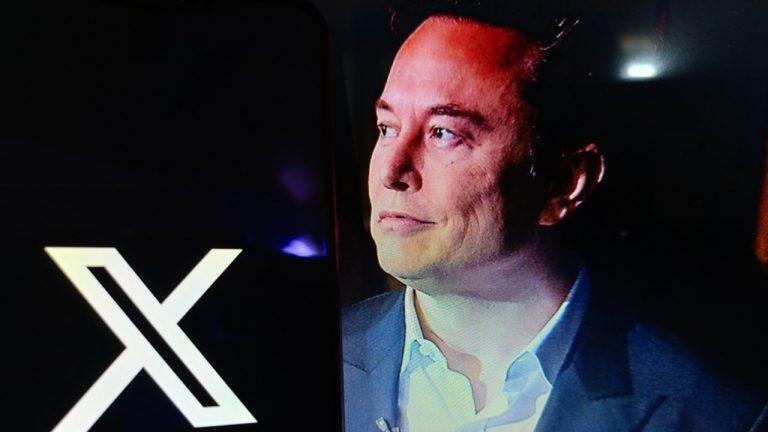
X is turning Cashtags into a more direct bridge between market conversation and trade execution. U.S. users can now move from a stock or crypto ticker on the platform to a participating brokerage or exchange with a single tap. Coinbase, Kraken Join X Cashtags as U.S. Trading Links Go Live X is pushing deeper into […]
 Bitcoin.com News•Emmanuel Musa16 Sept
Coinbase's limit-only mode for BLUECHIP-USD may impact liquidity and price discovery, affecting traders' strategies and market dynamics.
CryptoBriefing•Editorial Team16 Sept
The integration enhances operational efficiency and tax compliance for institutional crypto funds, potentially boosting their market participation.
CryptoBriefing•Editorial Team16 Sept
Solana's rise in spot asset volume signals a shift towards decentralized exchanges, challenging traditional centralized platforms' dominance.
CryptoBriefing•Editorial Team16 Sept
A strategist at the Danish bank said Coinbase has more at stake in the CLARITY setback because its trading business is directly exposed to US market-structure rules.
 Cointelegraph•Cointelegraph by Sam Bourgi16 Sept
Increased institutional Bitcoin inflows to Coinbase may signal heightened trading activity or strategic shifts in custodial practices.
CryptoBriefing•Editorial Team16 Sept
Coinbase's institutional growth strategy could significantly enhance its market position and revenue diversification, despite current price gaps.
CryptoBriefing•Editorial Team16 Sept
Coinbase's roadmap inclusion could boost token visibility and investor interest, impacting market dynamics and innovation in blockchain ecosystems.
CryptoBriefing•Editorial Team16 Sept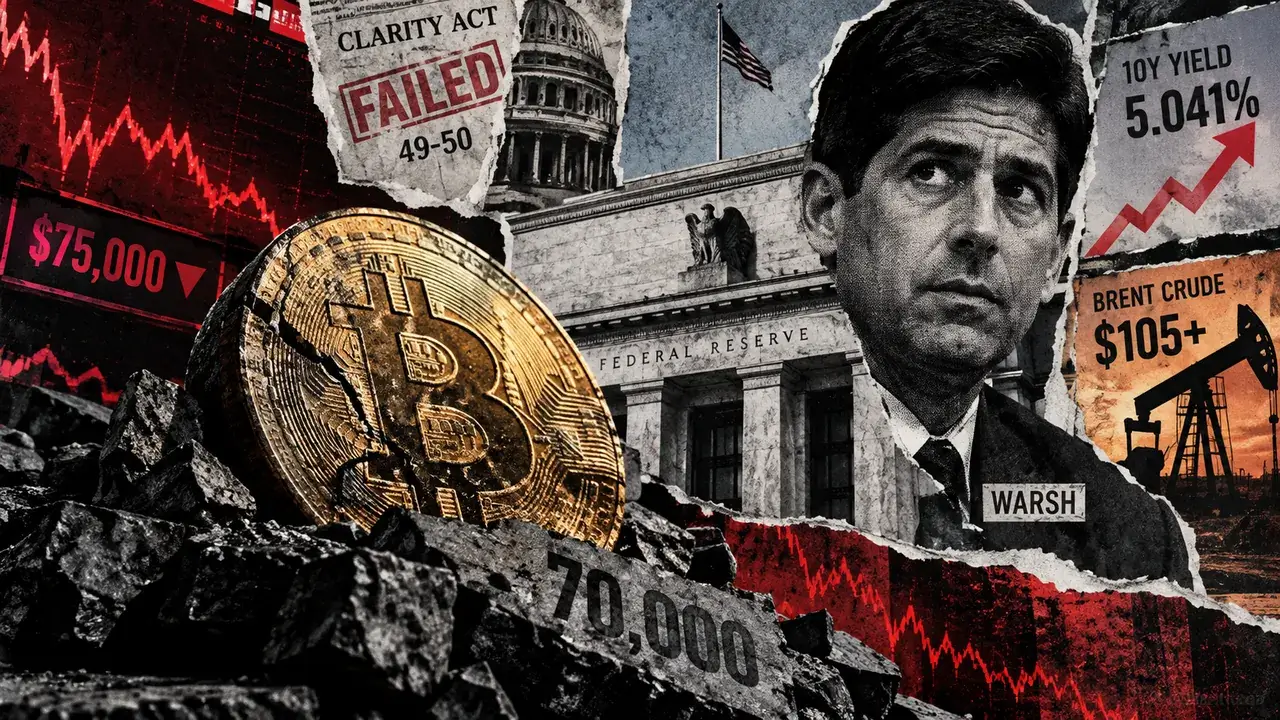
Bitcoin fell to an intraday low below $75,000 on Sept. 15, extending a selloff already underway ahead of the Senate vote on the CLARITY Act. The Senate failed 49-50 to invoke cloture on a motion to proceed to the bill, short of the 60 votes required, leading Bitcoin to its intraday low. Coinbase fell about […]
 CryptoSlate•Gino Matos16 Sept
Ahead of the Fed Decision Bitcoin has just absorbed one major shock and is about to face another: **the CLARITY vote failed, and the Fed decides in hours.** On September 15, the U.S. Senate failed to invoke cloture on the motion to proceed to the Digital Asset Market Clarity Act. The official vote was **49–50**, below the 60 votes needed to advance the legislation. This was a procedural failure to move the bill forward, not a final vote rejecting the bill itself. That distinction matters. Near-term regulatory certainty has been pushed further out. But one failed procedural vote does not, by itself, invalidate the longer-term case for digital assets. The market reaction helps show what was actually repriced. ## The Relative Damage Tells the Story Bitcoin fell about 4% after the Senate setback. Coinbase and Circle fell roughly 9% — about twice as much. That relative performance is important. If this were primarily a crisis of confidence in Bitcoin itself, Bitcoin should be at the center of the damage. Instead, assets with much greater exposure to U.S. regulatory outcomes were hit harder. That suggests at least part of the selloff was a **regulatory-premium adjustment**. For months, markets had increasingly priced in the possibility that comprehensive U.S. crypto rules were getting closer. When that timeline suddenly became less certain, companies whose business models depend heavily on U.S. regulatory clarity absorbed the larger shock. Bitcoin was pulled lower with them. But the Bitcoin network itself did not change because of the Senate vote. So the real question is not whether CLARITY was bad news. It clearly was for the near-term policy timeline. The question is whether the market is simply repricing that expectation — or beginning a broader structural breakdown. ## Regulation Has Slowed, Not Stopped Near-term congressional passage is now significantly more difficult. But the regulatory process has not returned to zero. The SEC proposed **Regulation Crypto Assets** in August, creating a tailored framework for certain investment contracts involving crypto assets. SEC Chair Paul Atkins has also said congressional legislation remains important for establishing more durable rules. So there are still two separate tracks: **Congressional legislation has slowed. Administrative rulemaking continues.** That does not guarantee CLARITY — in its current form or another form — will pass on any particular timetable. It simply means the Senate setback should be understood mainly as a delay in regulatory certainty, not evidence that the entire U.S. regulatory direction has reversed. For markets, timing matters. But timing and direction are not the same thing. ## The Fed Is the Second Test **The FOMC decision lands in hours. Markets are pricing a 25bp hike. What matters is what comes next.** The Fed releases its decision at **2:00 p.m. ET**, followed by Chair Kevin Warsh's press conference at **2:30 p.m. ET**. Markets currently assign roughly a **93% probability** to a 25-basis-point increase, taking the target range to **3.75%–4.00%**. Because the hike itself is heavily priced, the bigger variables are: * whether policymakers signal further tightening this year; * how concerned they remain about inflation; * how the Fed treats elevated energy prices; * and whether Warsh keeps future policy data-dependent or signals a more persistent hiking cycle. This matters because Bitcoin is not dealing with the CLARITY setback in isolation. The market is simultaneously removing regulatory optimism, reducing leverage and preparing for tighter monetary policy. That combination can produce a much larger short-term move than any single headline. ## Is This a Constructive Reset? It is too early to call the current decline a bottom. A constructive reset has to produce evidence. Over the next **48–72 hours**, four things matter. ### 1. Bitcoin Stops Making Impulsive New Lows Bitcoin does not need an immediate V-shaped recovery. But once the FOMC reaction has been fully absorbed, continued aggressive new lows would weaken the reset interpretation. Stabilization matters more than the first rebound. ### 2. Regulatory-Sensitive Assets Stop Underperforming Coinbase and Circle were hit roughly twice as hard as Bitcoin in the initial reaction. If that gap begins to narrow, it would suggest much of the regulatory premium has already been removed. If the gap keeps widening, the repricing is probably not finished. ### 3. Leverage Cools Without Another Disorderly Flush A healthy reset removes crowded positioning and allows the market to rebuild from a cleaner base. Cooling leverage followed by stable prices would be constructive. Weak prices combined with rapidly rebuilding leverage would not. ### 4. Bitcoin Absorbs the Fed The first move after an FOMC announcement is often noisy. The better signal comes after the statement, projections and press conference have all been digested. If Bitcoin can absorb both the regulatory disappointment and the Fed without starting another impulsive leg lower, the constructive-reset argument becomes much stronger. If it cannot, the correction probably has further to run. ## What Matters From Here The CLARITY vote changed something real: **the path toward near-term U.S. regulatory clarity became harder.** But the market now has to determine how much of that disappointment was already priced during the selloff — and whether the Fed adds a second layer of pressure. For short-term traders, the next 48–72 hours matter more than the last 48. Watch price stabilization, relative performance, leverage and the post-FOMC reaction. For longer-term investors, the more important question is different: Are institutional participation, regulatory development and the integration of digital assets into the financial system actually reversing? One failed procedural vote is not enough evidence to answer yes. The current move therefore deserves respect, but not an automatic conclusion that the broader crypto thesis has failed. **By tomorrow we'll know whether this is a one-punch or two-punch correction.** **Today, the evidence says the timeline broke, not the thesis.**
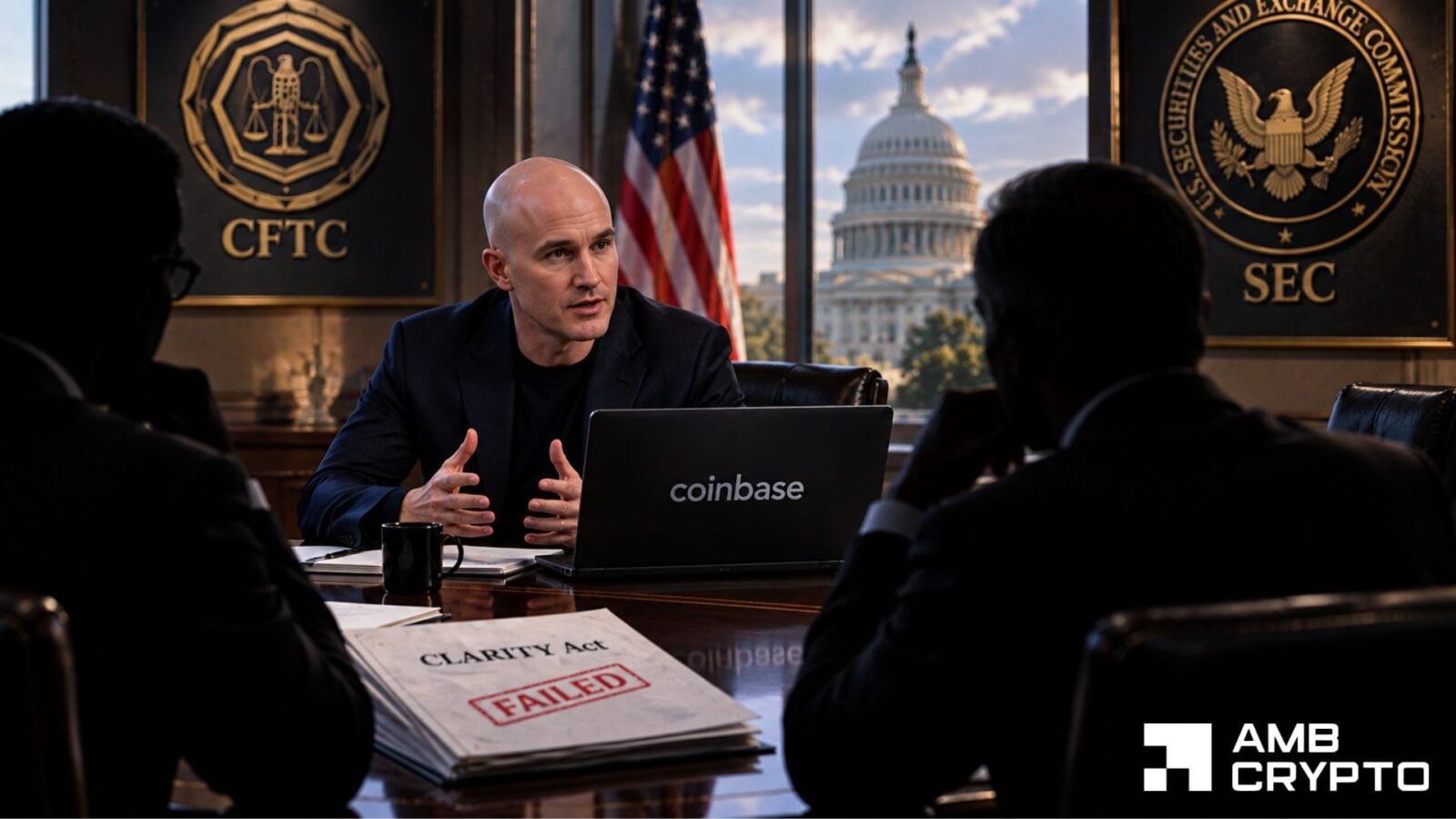
Fairshake’s reported strategy raises a harder question: what exactly earns the industry’s support?
 AMBCrypto•Benjamin Njiri16 Sept