
StarkWare CEO Eli Ben-Sasson links Zcash rise to Bitcoin ossification fears
Zcash's rise highlights shifting market dynamics, emphasizing adaptability and governance as key factors in crypto's evolving landscape.
 CryptoBriefing•Editorial Team8h ago
Zcash's rise highlights shifting market dynamics, emphasizing adaptability and governance as key factors in crypto's evolving landscape.
CryptoBriefing•Editorial Team8h ago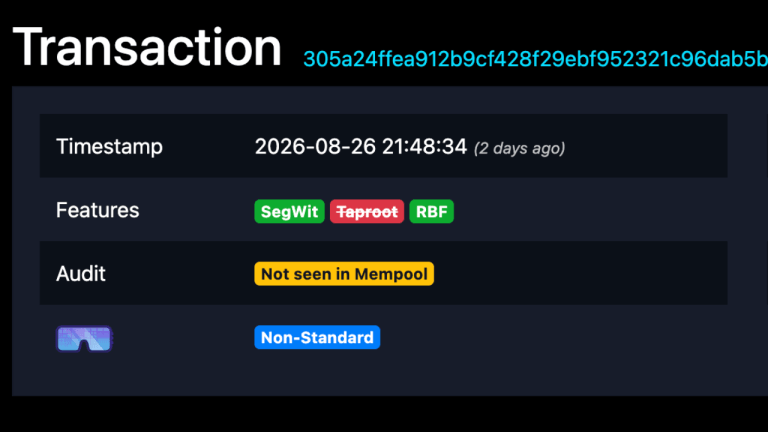
A quantum-resistant bitcoin transaction using Starkware researcher Avihu Levy’s QSB method has been mined on mainnet without a soft fork or changes to Bitcoin’s consensus rules. The experiment offers an opt-in defense against future quantum attacks, though it remains costly, nonstandard, and far from a network-wide solution. Starkware Shows Bitcoin Can Add Quantum Defense Without […]
 Bitcoin.com News•Emmanuel Musa29 Aug
StarkWare's quantum-safe method enhances Bitcoin's security, prompting future-proofing discussions and potential consensus-level changes.
CryptoBriefing•Editorial Team28 Aug
The transaction used Bitcoin’s existing rules to protect funds from a future quantum attack without requiring a network upgrade.
The onchain record confirms a 10,000-satoshi input and 5,179-satoshi fee; claims about quantum resistance come from StarkWare and the method’s author.
 The Defiant•The Defiant Team27 Aug
StarkWare said Wednesday that a quantum-safe Bitcoin (BTC) transaction has been mined on the live network, a first for the method. On-chain data shows the transaction spent a 10,000-satoshi output, worth about $8 at current prices, and paid a fee of 5,179 satoshis. Follow us on X to get the latest news as it happens
 BeInCrypto•Kamina Bashir27 Aug
StarkWare tests a quantum-resistant Bitcoin transaction on mainnet, showing a costly workaround that avoids changes to Bitcoin's consensus rules.

Bitcoin confirmed its first QSB transaction, testing quantum-resistant spending under existing consensus rules without a protocol upgrade.

StarkWare said the experimental transaction demonstrated quantum-resistant Bitcoin spending without a fork, but it cost up to $200 and required direct miner submission.
 Cointelegraph•Cointelegraph by Ezra Reguerra27 Aug
Still, StarkWare says Bitcoin needs a protocol-level upgrade to make it fully safe from quantum computing threats.
 The Block•Danny Park27 Aug
StarkWare's quantum-safe Bitcoin transaction highlights the urgent need for scalable, cost-effective quantum-resistant solutions in blockchain.
CryptoBriefing•Editorial Team26 Aug
StarkWare's focus on privacy and post-quantum security could redefine blockchain standards, pressuring competitors to prioritize these features.
CryptoBriefing•Editorial Team12 Aug
Chainlink Labs' strategic legal hire underscores the increasing need for robust legal frameworks as DeFi and traditional finance converge.
CryptoBriefing•Editorial Team4 Aug
StarkWare's Eli Ben-Sasson says Bitcoin's 21 million supply cap is flawed and wants a 4% inflation rate ceiling instead — but the community isn't having it.
StarkWare CEO Eli Ben-Sasson proposed 4% annual Bitcoin issuance, citing lost private keys, reviving debate over BTC’s 21M cap.

The proposal highlights the tension between maintaining Bitcoin's fixed supply cap and ensuring long-term network security through miner incentives.
CryptoBriefing•Editorial Team8 Jul
StarkWare CEO Eli Ben-Sasson argued that Bitcoin private keys get lost over time, meaning the amount of usable Bitcoin will diminish. Many disagree.
Cointelegraph•Cointelegraph by Brayden Lindrea8 Jul
“The crypto industry shouldn’t need wake-up calls from the White House or anyone else,” said StarkWare CEO Eli Ben-Sasson.
Cointelegraph•Cointelegraph by Martin Young30 Jun
StarkWare debuted a three-phase roadmap to make Starknet quantum-ready within months, according to the company.
The Block•Brian Danga30 Jun
StarkWare debuts Private KYC on Starknet using zero-knowledge proofs to verify user facts without exposing full identity data in KYC checks.