
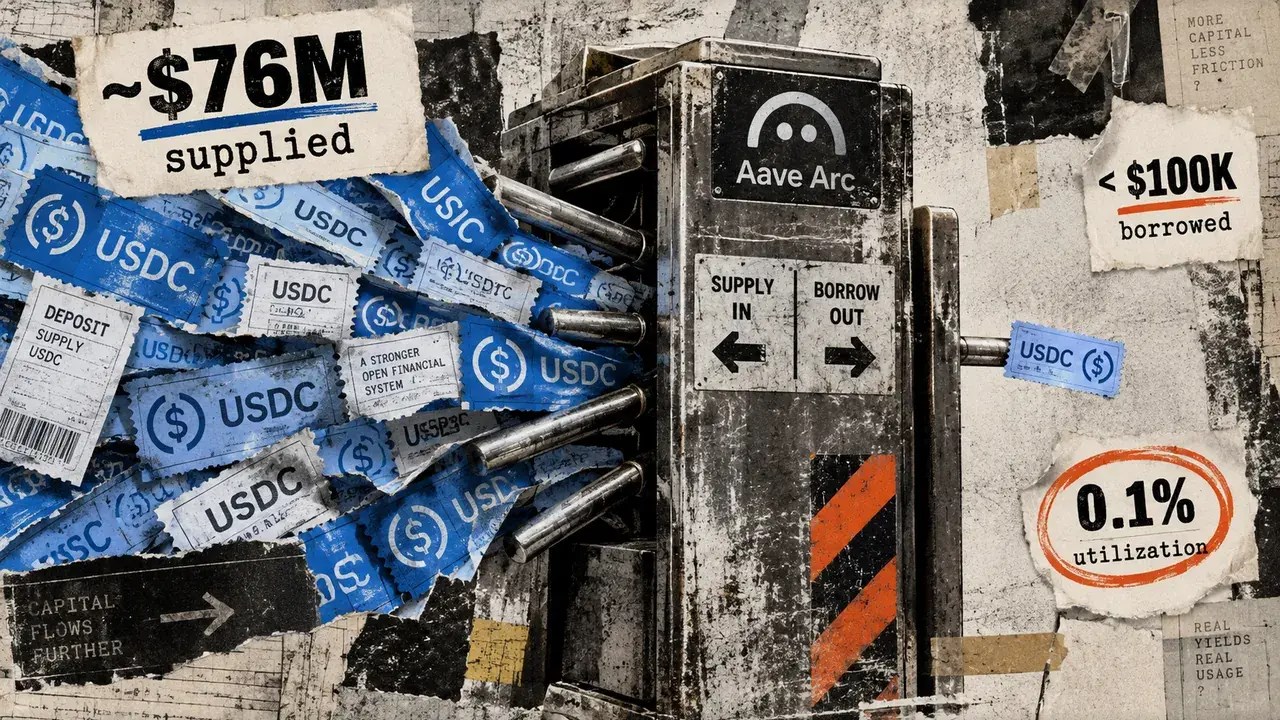
Aave V4’s Arc market is swimming in $76 million of USDC nobody is borrowing
Less than $100,000 was borrowed as utilization hovered near 0.1%, separating supply appetite from credit demand.
 CryptoSlate•Liam 'Akiba' Wright5h ago
Less than $100,000 was borrowed as utilization hovered near 0.1%, separating supply appetite from credit demand.
CryptoSlate•Liam 'Akiba' Wright5h ago
After a Senate setback for CLARITY, Stani Kulechov wants DeFi to force Washington’s hand through adoption, but Aave’s product layers reveal where regulators can still reach.
CryptoSlate•Liam 'Akiba' Wright12h ago
AAVE/USDT is shown on the 1D Binance chart, trading around 122.20 USDT. Price remains below a clearly defined descending resistance trendline, formed by a series of lower highs since the 2025 peak. The recent rebound toward the trendline makes the 140–145 USDT zone the key breakout area. Key levels: Resistance: 140–145 USDT Current zone: ~122 USDT Support: 100–105 USDT Major support: 90–95 USDT Deeper support: ~60 USDT A daily close above 145 USDT could provide breakout confirmation. If confirmed, the chart structure could open a move toward approximately 180–200 USDT, with 200 USDT representing roughly +64% from the current 122.20 USDT zone. If price is rejected from the trendline and loses 100 USDT, the bullish breakout structure may weaken, with 90–95 USDT becoming an important downside zone. Watch for a confirmed daily breakout rather than treating the trendline test itself as confirmation.

A single failed Senate vote this week wiped nearly 4% of the entire crypto market's value , and over 500 million dollars in forced liquidations across the market in the hours that followed. Bitcoin fell. Ethereum fell. Chainlink, Aave, Bitcoin Cash, Aptos, Ethena- every major name fell, most of them with no company-specific news of their own at all. This wasn't a hack, scandal, or technical failure - this was a legislative procedure vote that didn't pass. This article goes over exactly what happened, why leverage turns a political disappointment into a violent marketwide selloff , and why some coins fell far harder than others during the event. What actually happened The Senate failed to advance the CLARITY Act , a bill meant to set clearer regulatory rules for the crypto industry here in the US. Crypto markets had priced in progress toward this legislation, since regulatory clarity has been one of the biggest overhangs preventing broader institutional adoption for years. When the vote failed to advance the bill forward, that progress did not materialize, and the market reacted quickly. At the same time, rising odds of a Federal Reserve rate hike were already weighing on risk assets across the board. These two things - a disappointing regulatory outcome and rising expectations of tighter monetary policy - came together to form a single, sharp, risk-off move for the entire crypto market simultaneously. Why a bill not passing crashes coins that have nothing to do with the bill It's easy to confuse new traders as to why this happened. Chainlink, Aave, and Bitcoin Cash have entirely different use cases, teams, and fundamentals. None of them are directly regulated or affected by this specific legislation any more than any other token, but they all fell together, and several fell by more than Bitcoin did. This happens because crypto assets become highly correlated during a risk-off event . During such a move, traders and funds don't sell their disappointing bet and keep holding everything else in their portfolios steady. They reduce risk broadly across their entire portfolio , because the source of the fear - a regulatory uncertainty or a macro tightening expectation - applies to the asset class itself, and not to any coin's specific fundamentals. https://www.tradingview.com/x/bbQAXcS8/ Why leverage turns a dip into a $500 million cascade This is where the real damage multiplies. A large amount of crypto trading happens through leverage - that is, traders borrowing money to control a position bigger than their capital in order to magnify their gains. This works well while their prices march higher, but as soon as their prices start to fall by even a modest amount, the exchanges forcibly close, or liquidate, these leveraged positions to prevent the trader's losses from going beyond what they actually put up. As prices began to fall from the failed vote, leveraged long positions across many coins hit their liquidation thresholds. Exchanges automatically sold those positions into a falling market, which further pushed prices down, and then triggered the next layer of liquidations at a slightly lower price, and so on. This is how a single piece of news, one that might have caused a modest orderly pullback on its own, ended up resulting in over 500 million dollars of forced selling within a matter of hours , none of it a voluntary action by the traders involved. Why some coins fell so much harder than others Looking at the actual figures during the event, Aave fell over 6% , Aptos fell nearly 8% , Bittensor fell nearly 8% , and Bitcoin - the largest, most stable crypto asset - fell by a noticeably smaller percentage. This is because of something called beta , a measure of how much an asset tends to move compared to the broader market during a given event. Smaller, more speculative altcoins tend to carry higher beta than Bitcoin - that is, they tend to magnify any move the broader crypto market makes, in both directions. During a risk-off event like this, this higher beta works against the holders of these tokens, turning a moderate market-wide decline into a much sharper drop for these specific tokens. One analysis of Ethena's drop during this particular event specifically noted that the higher beta that Ethena typically has amplified what was a broad, macro-driven move, not something specific to the project. https://www.tradingview.com/x/D09OBE0t/ The bigger pattern worth understanding This is a signature you'll see repeatedly in crypto. A macro/regulatory headline hits . Broad, correlated selling begins across the entire asset class. Leveraged positions get forcibly closed , accelerating the initial move far beyond what the news itself would justify. Higher beta, more speculative tokens fall hardest , and larger, more established assets fall by comparison less, even though everything falls together. Recognizing this signature is important because it tells you that a sharp, broad selloff like this one isn't necessarily a judgment on any given individual project's fundamentals. It's often a mechanically-driven reaction to a single piece of news that happens to have occurred at a time when a large amount of leverage was sitting in the market. How to actually think about this as a trader Check if a crypto selloff is broad-based across unrelated tokens or concentrated in one coin, because a broad, correlated move implies a macro/regulatory trigger amplified by leverage, and not project-specific bad news. Pay attention to overall market leverage levels - sometimes visible around open interest and funding rates - because elevated leverage leading up to a known event can increase the odds that a disappointing outcome gets amplified into a much larger cascade than the news alone would justify. Remember that higher-beta altcoins will almost always move more than Bitcoin during both broad rallies and selloffs, so if you're holding small altcoins through a known event risk, you are essentially accepting amplified moves in both directions. Watch for the immediate aftermath of a liquidation cascade rather than only the initial drop, because these events can cause sharp, temporary overshoots to the downside as forced selling clears out, followed by a partial recovery once the leveraged positions causing the extra selling pressure have already been liquidated. My Conclusion A failed vote in Washington wiped out half a billion dollars in crypto positions within hours , and most of the coins' falls in the selloff had absolutely nothing to do with the bill itself. This is the nature of a leveraged, highly correlated market - a single piece of disappointing news doesn't just move the asset it's actually about, but it can cause a mechanical cascade across an entire asset class , hitting hardest wherever the most leverage and highest beta happen to be. Thank you @VertexQore

Aave founder Stani Kulechov sees an 'Uber path' for DeFi if U.S. crypto legislation stalls, he told The Starting Block.
 The Block•Kyle Baird16 Sept
Will Aave growth cross $20B as the lending protocol eyes stuck institutional capital at regulated custodians?
 AMBCrypto•Benjamin Njiri16 Sept
Aave has announced an Avalanche credit hub that will let institutions borrow USA₮ against tokenized assets as the RWA market exceeds $51 billion and Avalanche hosts more than $3.4 billion of the assets. Aave RWA Hub will turn tokenized assets…
The Aave V4 RWA Hub would let institutions borrow USA₮ against tokenized collateral on Avalanche. The hub and the USA₮ listing both go to an Aave DAO vote, and the release gives no launch date.
 The Defiant•The Defiant Team16 Sept
The Layer 1 charges gas in USDC and runs proof-of-authority across a permissioned set of 11 institutions plus Circle. More than 100 applications are live at launch, with Aave, Morpho and Uniswap anchoring DeFi. Circle minted 10 billion ARC tokens this week without committing to a public launch.
The Defiant•The Defiant Team16 SeptThe Layer 1 charges gas in USDC and runs proof-of-authority across a permissioned set of 11 institutions plus Circle. More than 100 applications are live at launch, with Aave, Morpho and Uniswap anchoring DeFi. Circle minted 10 billion ARC tokens this week without committing to a public launch.
The Defiant•The Defiant Team16 Sept
Aave's proposal could significantly enhance institutional participation in DeFi by offering secure, regulated collateral management, potentially increasing market stability.
 CryptoBriefing•Editorial Team16 Sept
Aave has recorded $27.4 billion in average total value locked during August as active loans climbed to $11.7 billion and its share of tracked on-chain lending reached 47.8%. Token Terminal’sAugust 2026 Aave report showed TVL rising 13.7% from July, while…
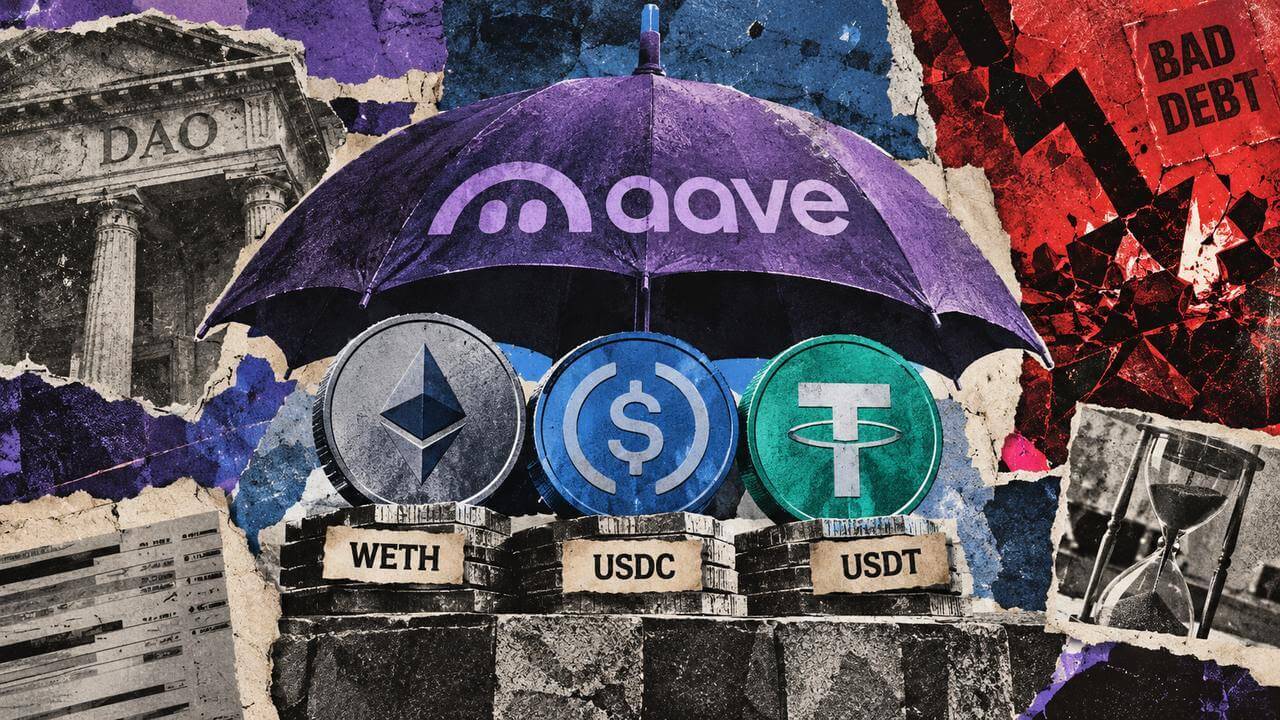
TokenLogic proposes Core WETH, USDC and USDT protection, with DAO offsets absorbing first losses before volunteer underwriters.
CryptoSlate•Liam 'Akiba' Wright14 Sept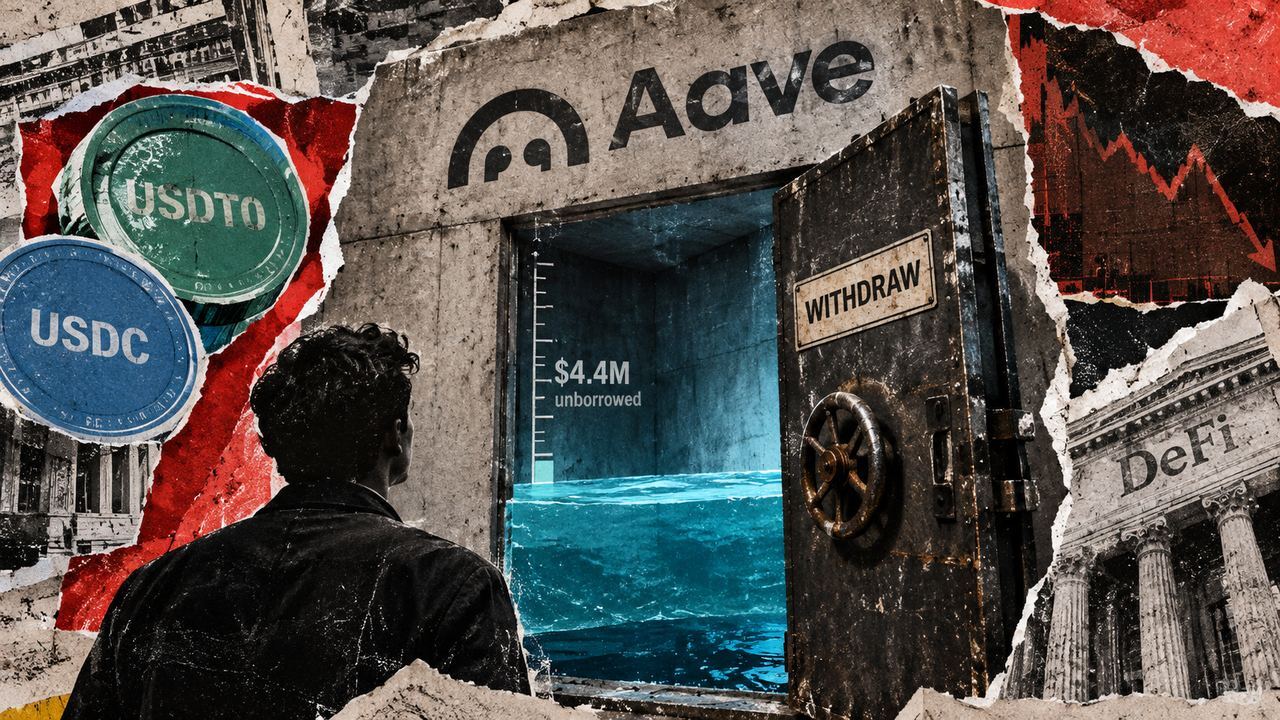
Monad USDT0 displayed a 6.10% APR with roughly $4.4 million unborrowed, showing why yield and withdrawal capacity need separate scrutiny.
CryptoSlate•Liam 'Akiba' Wright14 Sept
The CLARITY Act could significantly reshape DeFi by providing a clear regulatory framework, potentially increasing institutional participation.
CryptoBriefing•Editorial Team14 Sept
The proposed curve change adds 13 to 89 basis points across a $323.8 million debt snapshot.
CryptoSlate•Liam 'Akiba' Wright11 Sept
Aave sits $8 billion below its pre-hack deposits five months after the Kelp hack. Borrowers are asking what failed.
 BeInCrypto•Lockridge Okoth10 Sept
Aave's new Hub-and-Spoke architecture is closing in on $1B in deposits.

Aave's MCP server enhances AI-driven DeFi operations, streamlining data access and transaction preparation, potentially accelerating AI adoption.
CryptoBriefing•Editorial Team9 Sept
Aave's integration of USDe rewards in Ethena could enhance DeFi liquidity, attract yield-seekers, and stabilize synthetic dollar systems.
CryptoBriefing•Editorial Team7 Sept